
Myanmar’s New Anti-Money Laundering Law (2026): Key Changes and Compliance Implications
Author : Kaung Htet Zaw
: Shwe Yee Thein
Practice Area: Banking & Finance | Anti-Money Laundering (AML) | Regulatory Compliance
ANTI-MONEY LAUNDERING LAW (2026)
On March 11, 2026, the National Defense and Security Council enacted the Anti-Money Laundering Law, 2026 (Law No. 16/2026) (“AML 2026”). AML 2026 primarily regulates “Reporting Organizations”, which encompass banks, non-bank financial institutions, and designated non-financial businesses and professions. Although its primary obligations apply to Reporting Organizations, the enhanced customer due diligence (CDD), beneficial ownership verification, and transaction monitoring requirements are expected to have significant practical implications for businesses that rely on the banking system for domestic and international commercial transactions. Additionally, the law also imposes direct obligations on individuals and entities transporting cash, bearer negotiable instruments, precious metals, or precious stones across Myanmar’s borders where the prescribed declaration thresholds are met.
EVOLUTION OF THE ANTI-MONEY LAUNDERING LEGAL FRAMEWORK IN MYANMAR
The regulatory landscape governing financial compliance in Myanmar has evolved through three primary legislative stages:
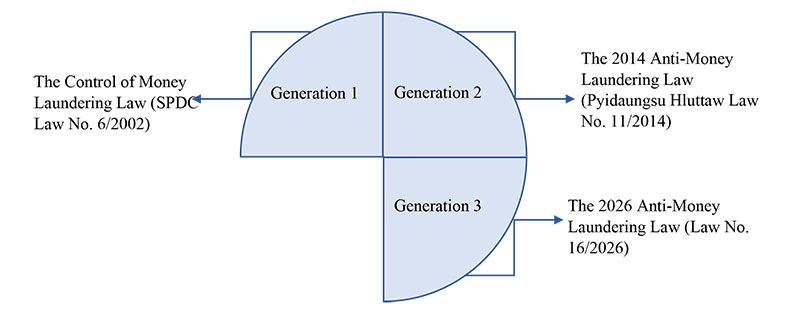
- Generation 1 (2002): The Control of Money Laundering Law (SPDC Law No. 6/2002) established the initial legal basis for controlling illicit funds and state confiscations.
- Generation 2 (2014): The 2014 Anti-Money Laundering Law (Pyidaungsu Hluttaw Law No. 11/2014) (“AML 2014”) introduced foundational concepts such as CDD and Suspicious Transaction Report (STR) for the banking sector.
- Generation 3 (2026 – Present): The AML 2026 establishes a modernized anti-money laundering framework with enhanced compliance obligations, strengthened enforcement mechanisms, and broader statutory liabilities.
- Repeal of AML 2014: Section 88 of AML 2026 explicitly repeals AML (2014).
Survival of Old Directive: Under Section 87 of AML 2026, all rules, regulations, notifications, directives, orders, and procedures issued under the 2002 and 2014 laws remain in force provided they do not contradict the AML 2026. Existing baseline compliance protocols are thereby maintained but are now subject to the heightened statutory penalties under AML 2026.
SCOPE AND APPLICABILITY
The mandates outlined in AML 2026 apply directly to all Reporting Organizations, which are legally defined to include:
- Commercial Banks
- Non-Bank Financial Institutions (NBFIs)
- Designated Non-Financial Businesses and Professions (DNFBPs)
Under Section 3 (g) of AML 2026, DNFBPs are specifically defined to include the following seven (7) categories of businesses and professionals:
(i) Casino;
(ii) Real estate agents;
(iii) Dealers in precious metals and gemstones;
(iv) Lawyers, notaries, legal professionals, and accountants when preparing or executing transactions for clients concerning:
- Buying and selling of real estate;
- Managing client money, securities, or other assets;
- Managing bank, savings, or securities accounts;
- Organizing contributions for the creation, operation, or management of companies;
- Creating, operating, managing, buying, or selling legal entities or business arrangements.
(v) Trust and company service providers offering services such as:
- Acting as a formation agent of legal entities;
- Acting as (or arranging for another person to act as) a director, company secretary, partner, or equivalent position;
- Providing a registered office, business address, accommodation, or administrative address for a legal entity.
(vi) Trustees acting as (or arranging for another to act as) a trustee of an express trust or equivalent legal arrangement.
(vii) Nominee shareholders acting as (or arranging for another to act as) a nominee shareholder for another person.
EXPANDED SCOPE OF PREDICATE OFFENCES
Section 5 of AML 2026 specifies the offences from which proceeds may constitute money laundering. The principal categories are summarized below.
| Category | Offences included under Section 5 of AML 2026 |
|---|---|
| Organized Crime | Transnational organized crime, participation in criminal organizations, racketeering |
| Terrorism | Terrorism and the financing of terrorism |
| Human Exploitation | Human trafficking, migrant smuggling, sexual exploitation of children |
| Trafficking Offences | Drug trafficking, illicit trafficking in arms, illicit trafficking in stolen goods and other goods |
| Financial and Commercial Crimes | Corruption, bribery, fraud, forgery, currency counterfeiting, counterfeit goods, intellectual property offences, extortion |
| Violent Crimes | Murder, causing grievous bodily harm, kidnapping, unlawful detention, hostage-taking, robbery and theft |
| Trade, Tax and Regulatory Offences | Smuggling (including customs, excise and duties), tax offences (including direct and indirect taxes), offences relating to controlled chemicals |
| Environmental and Technology- | Environmental crimes, cybercrime |
| Market Misconduct | Insider trading and market manipulation |
| Other Predicate Offences | Gambling, piracy, any offence punishable with imprisonment of at least six months under any existing law, and any other offence prescribed by the Central Body with the approval of the Union Government |
KEY CHANGES
The following table outlines the fundamental shifts in compliance enforcement affecting corporate operations:
| Compliance Area | AML 2014 | AML 2026 |
|---|---|---|
| Corporate Identification | Reporting Organizations were required to conduct customer due diligence, identify and verify customers and beneficial owners, understand ownership and control structures, and apply a risk-based approach before establishing business relationships and conducting specified transactions (Section 19). | Reporting Organizations are now legally mandated to identify and verify the human “Beneficial Owner(s)” exercising ultimate control over the corporate entity (Section 27). |
| Cross-Border Logistics | Cross-border transport of cash, bearer instruments, or precious stones/metals meeting a specified threshold required declaration to the Customs Department (Section 39). | Border crossings function as strict AML checkpoints. Mandatory declarations remain required for the transport of cash, bearer instruments, and precious metals meeting specified thresholds (Section 48). |
| Corporate Liability | A company convicted of money laundering faced a fine up to 500 million kyats, while the owner or beneficiary faced up to 7 years imprisonment (Section 43). Failure to declare at customs resulted in a corporate fine up to 300 million kyats (Section 47). | Companies face fines up to 500 million MMK for money laundering (Section 58), while “Beneficial Owners” face direct imprisonment (6 months to 2 years) and personal fines of 100 million to 300 million MMK. |
ESSENTIAL STATUTORY PROVISIONS FOR COMMERCIAL OPERATIONS
(i) Cross-Border Transport and Customs Declarations (Chapter 11)
AML 2026 heavily regulates the physical movement of high-value assets across Myanmar’s borders.
- Section 48: Any individual transporting cash, bearer negotiable instruments, precious stones, or metals meeting a specified threshold into or out of Myanmar is legally required to make a formal declaration to the Customs Department. This applies whether the assets are carried on a person, in luggage, via vehicles, or within cargo shipments.
- Section 49: The Customs Department is mandated to seize any undeclared or falsely declared cash and instruments, and to initiate AML investigations.
- Section 65: Non-compliance with Section 48 carries severe criminal liability. Individual offenders face 6 months to 1 year of imprisonment and/or a fine up to 100 million MMK. If the offense is committed on behalf of a corporate entity, the company faces a fine of up to 300 million MMK. The undeclared assets are also subject to confiscation as state funds.
(ii) Enhanced Financial Scrutiny and Corporate Transparency (Chapter 9)
- Beneficial Ownership Verification (Section 27): Reporting Organizations must identify the “Beneficial Owner” of a company and verify their identity. Banks are required to maintain a full understanding of a corporate client’s ownership and control structure before processing international wire transfers or establishing business relations.
- Suspicious Transaction Reports (Section 39): Reporting Organizations are compelled to immediately file a STR to the Financial Intelligence Unit (FIU) if a transaction is suspected of involving proceeds of crime or terrorism financing.
- Record Retention (Section 31): Reporting Organizations must maintain comprehensive records of transactions, account files, and business correspondence for a minimum of five years following the completion of a transaction or the closure of an account.
WHAT REPORTING ORGANIZATION AND BUSINESSES SHOULD DO NOW
In practical terms, AML 2026 signals a transition from a compliance-focused regime to a liability-focused regime, where failures in transparency, reporting, and due diligence may expose both corporate entities and their beneficial owners to substantial financial penalties, criminal sanctions, and asset confiscation. Early assessment of existing compliance frameworks and timely implementation of necessary enhancements will be essential to mitigate regulatory and enforcement risks under Myanmar’s new anti-money laundering landscape.
Commercial banks, non-bank financial institutions, and DNFBPs should therefore review and strengthen their internal AML policies, customer due diligence procedures, beneficial ownership verification mechanisms, transaction monitoring systems, and employee training programs to ensure compliance with the new legal requirements. Businesses engaged in cross-border transactions should also pay particular attention to customs declaration obligations and enhanced scrutiny of fund movements.
Disclaimer: The information provided in this newsletter is for general informational and educational purposes only and is not intended to be, nor should it be interpreted as, legal advice or a formal legal opinion. No reader should act, or refrain from acting, based on the contents of this update without first seeking professional legal counsel tailored to their specific circumstances and jurisdiction. For comprehensive legal support or specific inquiries regarding your company’s compliance, please contact our team directly at firm@iicole.com.
Key Contacts

Kaung Htet Zaw
Partner
T. 95-9-422525375
E. khz@iicole.com

Shwe Yee Thein
Paralegal
T. 95-9-453207299
E. syt@iicole.com
Contact Us
Address
Room No.106, Rangoun Business Centre, No.97, West Shwe Gone Ding Street, Bahan Township, Yangon, Myanmar.
Phone
+95 975 277 8589